


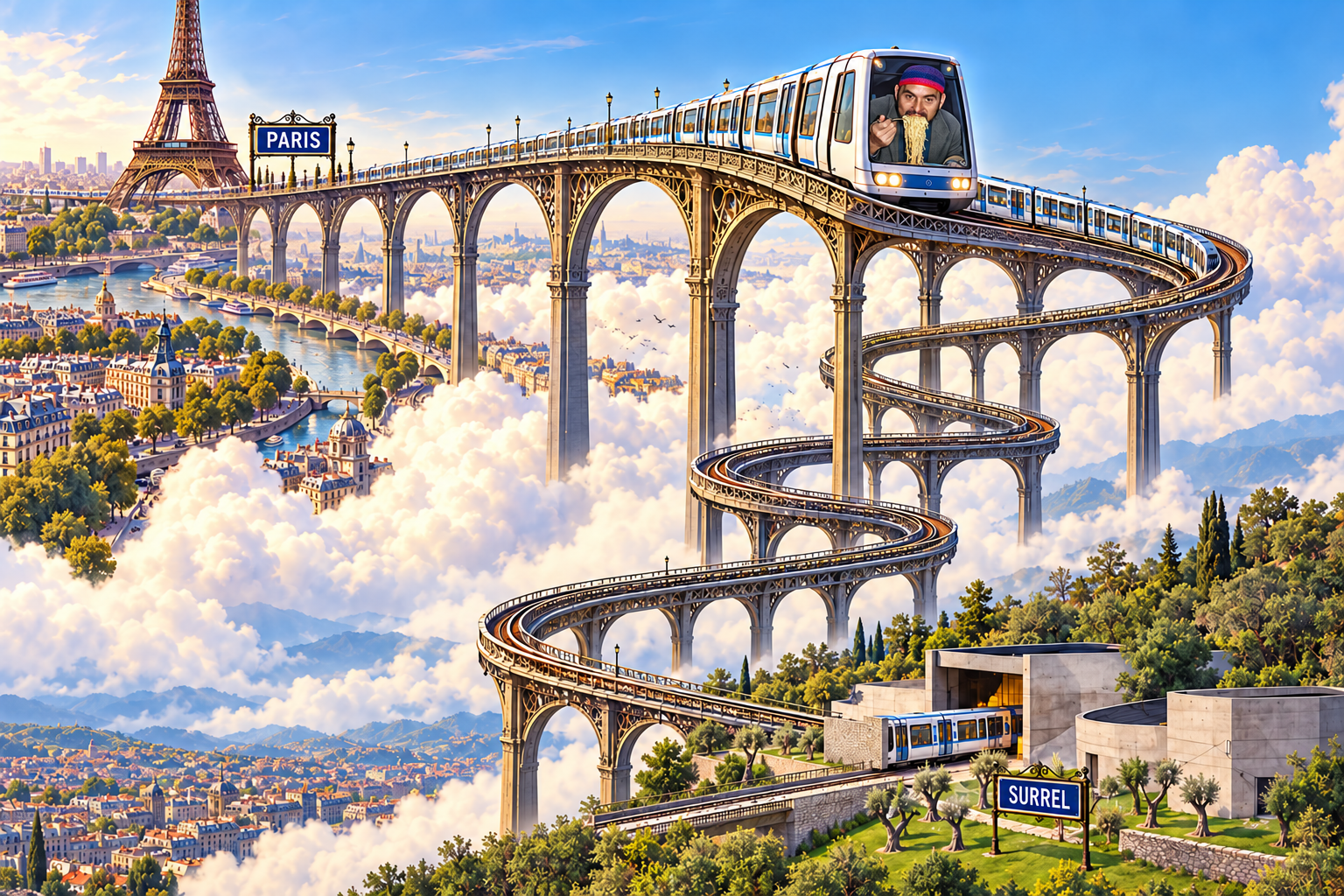
 A humorous image of the imaginary Paris–Surrel express train.
Paris october, 23, 2026
In a small country, a police shield does not conceal an entire life. Behind it stands someone whose family, neighbourhood and name may be known to those on the other side. When an officer strikes a young person already lying on the ground, the blow travels beyond the square. It enters homes. For those who lived under dictatorship, it opens a door they thought had finally closed.
Violence elsewhere in Europe offers no justification. Every country carries its own history; Albania carries the memory of a state before which people learned to lower their voices. No government should make that gesture necessary again.
The reported €2,500 bonus for officers deployed during the protests raises a question: what recognition is being offered, and what accountability accompanies it? A payment alone does not establish that violence was ordered or rewarded. But where allegations of excessive force remain unresolved, applause from above can sound like permission below.¹
A prime minister’s duty is to prevent the country from dividing into those who command, those who strike and those who must endure. Police officers should not have to choose between their livelihoods and their obligations to the public. Protesters should not have to wonder whether the uniform before them still belongs to a state that protects them.
The social contract begins to break when citizens cease to recognise themselves among those whom power serves. No bodyguard can repair that breach. No speech about national honour can substitute for restraint.
There comes a moment when leadership means allowing another voice to finish a sentence—and accepting that its final word may be “leave.” Resignation can preserve what force destroys: the possibility of returning to public life without asking others to forget.
And then there is the railway. The European Investment Bank has described Albania’s passenger and freight services as barely operational.² If the remark about stopping protesters from taking the train is accurately reported, one practical difficulty remains: before preventing citizens from boarding, the government might first arrange for a train to exist.
Resist, certainly, but do not let every provocation become an invitation to repeat the prime minister’s name. Keep the attention on citizens and their demands. Politics sometimes looks less like government than an exhibition whose artist refuses to let the visitors leave.
One can almost imagine the publicity advice: “Why settle for an audience at a gallery when a fresh scandal can fill every screen?” An imaginary adviser, admittedly, but the distinction between governing a country and promoting a solo career deserves to remain real.
Perhaps the Paris–Surrel Express offers the perfect compromise: a private carriage, a generous plate of pasta, and an audience safely out of earshot.
—
¹ KOHA, “The Albanian Government Approves a 2,500 Euro Reward.”
² European Investment Bank, “EU Support Helps Revamp Rail Transport in Albania,” September 18, 2025.
© klarabudapost.com CC
#ParisSurrelExpress #PoliticalSatire #ImaginaryTrain #Albania #EdiRama #PoliticalHumour #ArtAndPower