


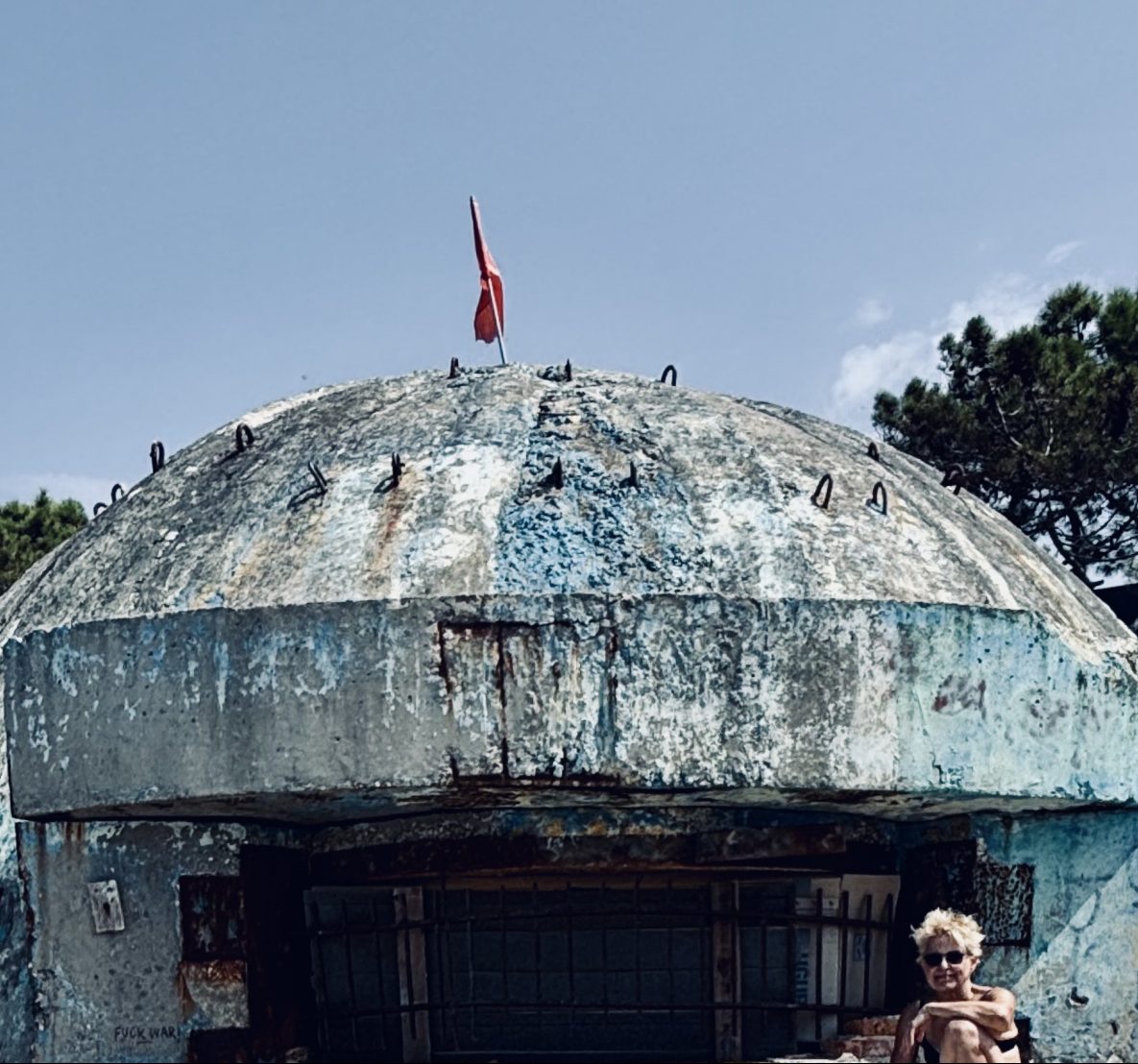
 Figure … Klara Buda beside a communist-era bunker on the Adriatic coast, Durrës, Albania, August 30, 2026. Photograph by Vigan Dervis. Private collection of the author.
 Durrës, Albania, August 30, 2026.
“Once something terrifying becomes part of everyday life, people stop noticing it.”
Sitting beside an old communist bunker on the Adriatic, I wonder: what can fiction know that the archive cannot? The concrete is still here, stubborn against the sand and sea. Once, this bunker watched the horizon for an enemy that might come. People walked past it, lived beside it, grew accustomed to its presence. After a while, perhaps, they hardly saw it anymore.
Now I sit against the same concrete, barefoot, facing the sea. The bunker remains; its purpose does not. What was built to watch, defend, and frighten has become something to lean against. I sit, almost carelessly, in a space once shaped by paranoia. The concrete is still beneath me. The sea is the same.
Perhaps this is where the counter-archive begins: not outside the remains of history, but inside them, when another body, another time, another narrative inhabits what is left and gives it another life. The archive can preserve the bunker, its date, its military purpose, its place within the machinery of dictatorship. It cannot preserve the ordinary intimacy of living in its shadow: fear becoming habit, silence no longer felt as silence, the small gestures through which people learned to live in an abnormal world as though it were normal.
Fiction begins there, where the document falls silent. Not to erase the archive, nor to compete with its facts, but to enter its silences. The bunker can testify that dictatorship existed. Fiction can listen for what remains after the guards have gone, the imagined enemy has disappeared, and this architecture of fear is still here, facing the sea.
Copyright klarabudapost.com