


Paris, January 29, 2026
When Diagnosis Becomes an Urgency: Thinking America with Avital Ronell
— A Philosophical Diagnosis of Contemporary Disorientation
Drawing on a recent conversation, Avital Ronell offers less a conjunctural analysis than a philosophical diagnosis: that of a mutation in the relation to truth, rationality, and public thought in the United States. This text explores its main lines of force.
I
There are moments when certain words, long held at a distance out of analytical caution, return to knock at the door of philosophical discourse. Fascism is one of them. No longer as a strictly historical category tied to the catastrophes of the twentieth century, but as an anxious hypothesis: an attempt to name a transformation whose forms remain unstable, yet whose effects are becoming increasingly perceptible.
When Avital Ronell evokes the American situation, it is neither to indulge in alarmism nor to rehearse familiar rhetorics of democratic decline. Her speech proceeds otherwise: it diagnoses, in the clinical and philosophical sense of the term. America no longer appears merely as a power in crisis; it becomes the site of a deeper mutation, where the relation to truth, the authority of language, and the very conditions of public rationality are being simultaneously reconfigured.
What is troubling, then, is not only political polarization, nor even the brutalization of debate. It is the rise of a form of irrationality now capable of constituting itself as a principle of government—an irrationality that no longer confronts knowledge head-on, but patiently erodes it, renders it suspect, sometimes superfluous. Stupidity—perhaps one should say bêtise—in this perspective no longer belongs to individual cognitive failure; it tends to become a shareable structure, almost an atmosphere.
Such a displacement may mark a historical threshold. Liberal democracies implicitly rested on a minimal trust: the belief that facts, even if not always respected, remained at least contestable within a shared space of verification. What happens when that space itself falters? When truth ceases to function as a horizon and becomes one option among others—negotiable, interchangeable, sometimes indifferent?
It is at this point of inflection that language itself becomes insufficient.
Here, the word fascism, stripped of its inflationary uses, regains a heuristic function. It does not necessarily designate the return of classical forms of dictatorship; rather, it signals the possibility of a regime in which collective disorientation becomes politically exploitable, where confusion is no longer an accident but a resource.
Ronell does not propose a systematic theory of this mutation. Her gesture is more risky: she captures its signs, its inflections, its still-diffuse vibrations. Her thought operates less as an explanatory apparatus than as a seismograph attentive to the micro-tremors of the present.
In this context, the conversation in which her voice unfolds deserves attention—not as a media object, but as a space of thought—not only for its argumentative content, but because it makes visible a condition that has become rare: a space where philosophy can still risk a diagnosis without being immediately reduced to pedagogy or polemic.
For diagnosing is not commenting. It is accepting to speak from a zone of uncertainty, where inherited categories no longer fully suffice, yet where silence would already constitute a form of renunciation.
Such speech, however, still requires a place in which to appear.
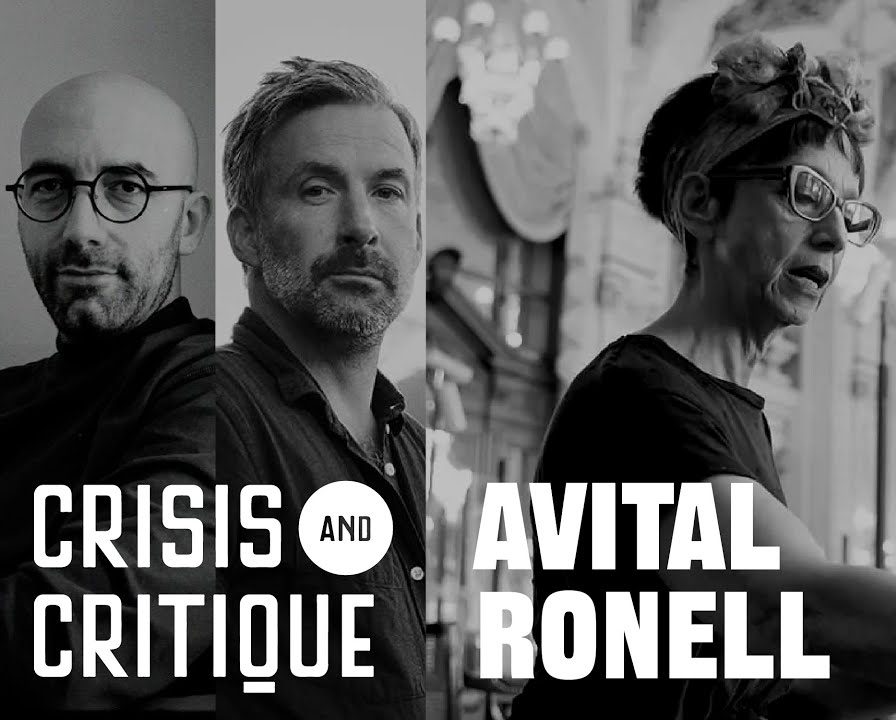
The conversation bringing together Ronell, Agon Hamza, and Frank Ruda offers, in this respect, a singular configuration. At no point does the discussion succumb to the agonistic temptation that often threatens intellectual scenes. A perceptible restraint—one might describe it as a suspension of rivalry—opens a space sufficiently cleared for thought not to be forced into self-defense.
This point is not anecdotal. Philosophy never comes into being under conditions of heightened narcissistic pressure. It requires, in order to move, a zone of low pressure where discourse can explore without being immediately compelled to conclude.
In such a climate, Ronell’s speech unfolds at a rhythm that exceeds simple exposition. Sentences lengthen, bifurcate, associate; thought does not follow a predictable trajectory—it takes shape in the very movement that carries it. What we hear, then, is not the delivery of stabilized knowledge, but the activity of an intelligence in the process of seeking its own lines of force.
One must take the measure of this phenomenon: a living thought is never entirely contemporaneous with itself. It advances slightly ahead of what it already knows. When this advance is neither interrupted nor excessively disciplined, something occurs that exceeds the ordinary framework of the interview. Discourse ceases to be a mere vehicle; it becomes productive. Ideas appear that were not fully programmed—perhaps not even for the one who speaks.
It is at this precise point that philosophy once again becomes an event. A thinking event is not recognized by the spectacular novelty of a thesis nor by conceptual virtuosity. It occurs when language no longer merely articulates what is thought, but becomes the very site in which thought takes form. Such an occurrence remains rare within the contemporary media ecosystem, structured by acceleration, simplification, and the imperative of mastery.
Allowing a discourse to retain its complexity already constitutes an act of resistance. For what Ronell’s diagnosis allows us to glimpse exceeds the American case alone. What is at stake may concern late democracies more broadly: a moment in which the authority of facts weakens, the fatigue of rationality renders political fictions more desirable than the constraints of the real, and symbolic violence becomes so normalized as to appear almost invisible.
We may be witnessing less a crisis than an anthropological reconfiguration—a transformation of the political subject itself, now exposed to regimes of belief capable of coexisting with their own negation. In such a landscape, the task of philosophy can no longer be limited to clarifying inherited concepts. It also consists—perhaps first and foremost—in developing a sensitivity to emerging forms of danger.
To diagnose, then, is not to predict. It is to refuse to see only once everything is already visible. And if such moments of thought matter today, it may be because they remind us of a truth that has become fragile: philosophy is not merely a discipline. It is a situation—precarious, demanding—that depends on an always-threatened balance between speech and listening, structure and drift, knowledge and inquietude.
When that balance is achieved, even briefly, dialogue ceases to be a mere exchange; it becomes the place where thought, once again, can arrive.
Only at this price does philosophy remain contemporary with what threatens it.
II
The Diagnosis of America
— A Genealogy of Disorientation**
When Ronell speaks of the current state of America, she is not describing a conjunctural crisis. Her remarks are situated within a longer temporality: that of a process already underway, whose contemporary manifestations merely intensify its visibility.
The implicit question, therefore, is not simply: what is happening?
It is more radical:
How did we get here?
Her diagnosis rests on several major displacements.
1. The Erosion of the Regime of Truth
At the foundation of her analysis lies the idea that modern democracy presupposed a minimal trust in the possibility of truth—not consensus, but the existence of a shared space in which facts could still carry authority.
That foundation is weakening. We appear to have entered a moment in which:
-
truth becomes optional,
-
verification loses its prestige,
-
contradiction no longer invalidates.
This phenomenon does not merely belong to the classic register of political lying. It signals a deeper mutation: truth ceases to function as a structural constraint and becomes one element among others in the struggle between narratives.
What disappears, then, is not truth as such, but the collective need for truth to bind.
2. Stupidity as a Political Force
One of the most incisive gestures of Ronell’s diagnosis consists in displacing the notion of stupidity.
In her account, stupidity is neither an individual weakness nor a lack of education. It becomes a mobilizable energy, sometimes even a strategic resource.
This point is crucial. A democracy can survive conflict, error, even deception. It has far greater difficulty resisting when irrationality itself acquires public legitimacy.
Stupidity then ceases to be a defect; it becomes a political style.
More than that: it can produce a sense of community—one founded not on the sharing of truth, but on distrust toward any demand for complexity.
We are no longer simply facing ignorance, but a withdrawal from intelligence itself.
3. The Fatigue of Rationality
Another thread runs through Ronell’s remarks: the diffuse impression that modern rationality has lost its capacity to attract. Thinking requires effort; simplification provides relief.
In this context, authoritarian discourses do not necessarily triumph through coercion. They prosper because they offer an immediate legibility of the world, even if fictive. This is where the diagnosis becomes more troubling: the drift does not proceed solely from a will to dominate, but also from a desire for cognitive rest.
A society that is intellectually fatigued becomes vulnerable to narratives that promise clarity without complexity.
4. Why the Word “Fascism” Becomes Thinkable Again
Ronell does not employ this term as a rapid historical analogy. It functions instead as a limit-concept, an instrument for thinking what occurs when several lines of fragilization converge:
-
the weakening of truth,
-
the normalization of discursive brutality,
-
the political exploitability of confusion,
-
the attraction of simplifying forms of authority.
Fascism, in this perspective, does not necessarily refer to the return of twentieth-century regimes. It designates the possibility of an order in which collective disorientation becomes governable. In other words: not the return of the same, but the emergence of a new form of permissive authoritarianism.
5. A Mutation Rather Than a Crisis
This point deserves to be emphasized strongly.
A crisis presupposes a before and an after. A mutation durably transforms the conditions of what can be thought.
What Ronell allows us to glimpse resembles less a moment of turbulence than a displacement of the political subject itself, now exposed to regimes of belief capable of coexisting with their own negation. We may be entering an era in which knowing that a statement is false no longer prevents adherence to it. This paradox marks an anthropological threshold.
6. What This Diagnosis Obliges Us to Think
The scope of Ronell’s analysis extends far beyond the American case. America appears here as a laboratory—not because it is exceptional, but because it renders visible tendencies that traverse other democracies as well.
Three philosophical demands follow from this diagnosis.
First: to develop a sensitivity to early signs. To diagnose is less to register what is already evident than to perceive what has not yet fully manifested itself.
Second: to refuse banalization. What becomes habitual ceases to provoke concern, and it is precisely in this way that historical thresholds are crossed without being named.
Third: to preserve the conditions of thought itself. For what is at stake is not only the future of institutions, but the possibility of a space in which truth continues to exert constraint.
The American philosopher Avital Ronell, in dialogue with Agon Hamza and Frank Ruda for Crisis and Critique, January 20, 2026.
#AvitalRonell #DiagnosticPhilosophique #RégimeDeVérité #Désorientation #NoocidalPolitics #MutationAnthropologique #ConditionsDuPensable #ÉvénementDePensée
© Klarabudapost.com
CC