


Pristina, 12 February 2018
“The idea of Kosovo’s unification with Albania, increasingly articulated in the media, paradoxically serves as a crutch for the partition of Kosovo.” — KB
At this precise moment, the promotion of unification between Albania and Kosovo functions as an instrument serving the idea of Kosovo’s partition and, as such, runs counter to the Albanian national interest.
I have previously expressed my position on the issue of Kosovo–Albania unification.
First, Kosovo has been defined as a multiethnic state, not an ethnic Albanian state. As a result of this institutional structure, its parliament faces significant difficulty in securing a majority even on matters of political survival, let alone deciding on unification with Albania.
Second, Kosovo–Albania unification—an enduring aspiration of Albanians since Kosovo’s separation from the national body—can only be realized under conditions of stable and functional states. Today, under the grip of systemic crime, both states lack the capacity to govern internal challenges, let alone achieve national unification.
There is a clear hypocrisy and manipulation of public opinion by political leaders in both Kosovo and Albania who advocate for unification. They fail to explain how such an aspiration could be implemented within Kosovo’s current parliamentary framework and deliberately overlook its consequences: namely, the demands of Kosovo Serbs for the establishment of an Association of Serb Municipalities, which would institutionalize a “Republika Srpska” within Kosovo and serve as justification for the unification of northern Kosovo with Serbia.
However, this is not the central focus of this article. Rather, it seeks to demonstrate that advocating for Kosovo’s unification with Albania at this particular moment—before resolving the Kosovo–Serbia dispute—effectively supports the partition of Kosovo and undermines Albanian national interests.
If we accept that unification is currently unfeasible—due both to deep criminalization within the states and to Kosovo’s constitutional constraints—then it becomes clear that such declarations serve other purposes. Beyond functioning as political smoke screens, they play a more strategic role: facilitating public acceptance of Kosovo’s partition.
Although seemingly paradoxical, the idea of unification—advanced in parallel with proposals for border correction—helps normalize the latter in public opinion and thus serves, indirectly, the project of partition and the creation of a Greater Serbia.
What are the key narratives that contribute to making this central Serbian idea of Kosovo’s partition more acceptable?
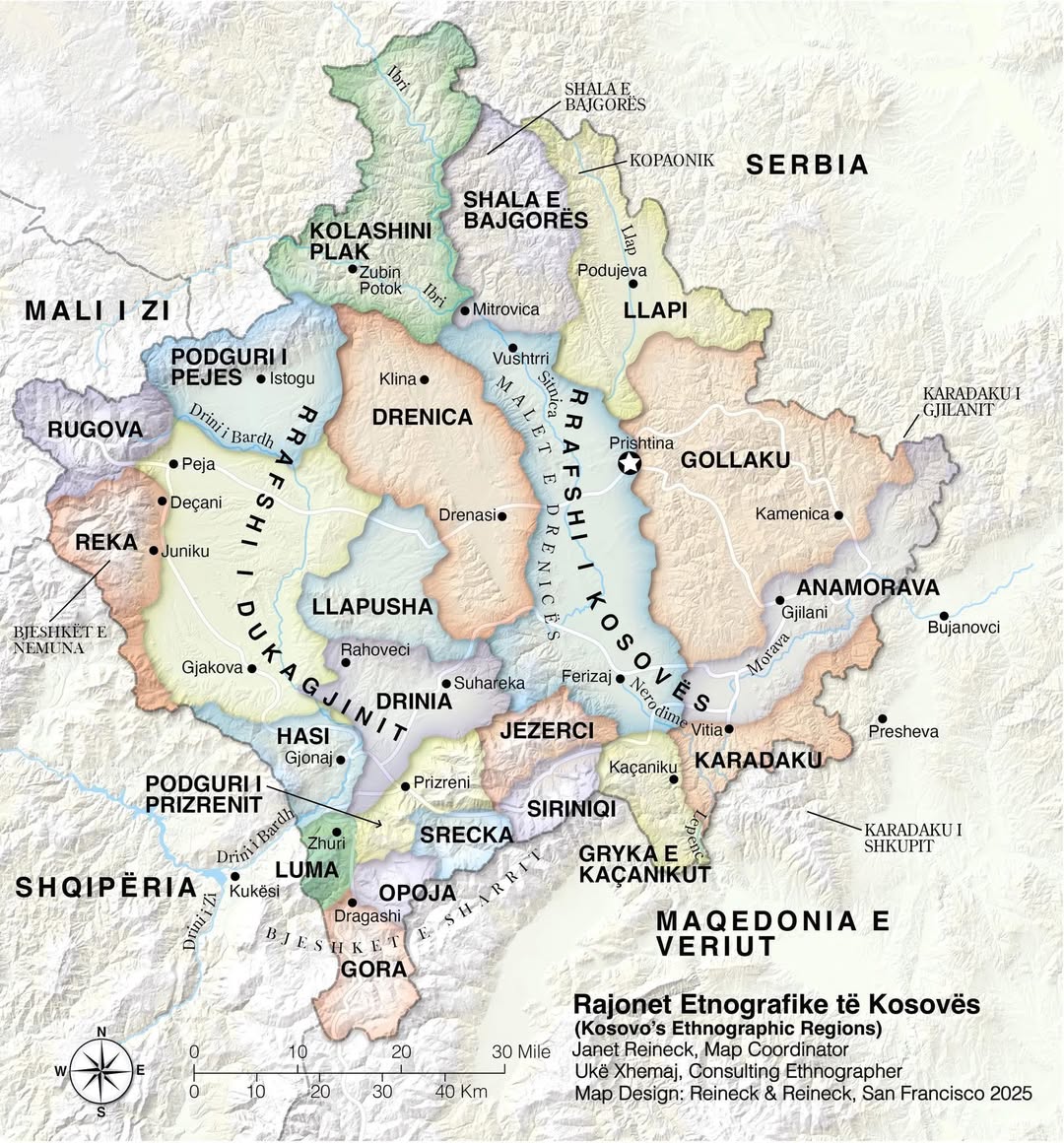
I – The unification of Presheva with Kosovo
Presheva is a region abandoned by the Serbian authorities, from which Albanians have emigrated to such an extent that in some villages there are too few children to sustain Albanian-language schooling or even basic services such as maternity care. Moreover, it is an area lacking significant natural resources and represents a burden for Serbia.
II – The unification of Albania with Kosovo
If northern Mitrovica (including the Trepça mines and Lake Ujman) were to be annexed by Serbia, Kosovo would lose the majority of its natural resources and would struggle to survive economically. For this reason, the idea of partition faces resistance among public opinion. The promise of unification with Albania is then used as bait: while Trepça and Ujman are lost, Kosovo would gain access to the sea and, together with Albania, become economically viable.
This raises the question: why has Serbia, at this particular moment, abandoned its longstanding accusations regarding a “Greater Albania”? This fact further supports the hypothesis that the unification narrative is merely a tool serving the partition of Kosovo and the annexation of its resource-rich north by Serbia.
In conclusion, however paradoxical it may seem, the idea of Kosovo–Albania unification, when articulated alongside border correction, contributes to the acceptance of this option by public opinion and runs counter to Albanian national interests. Unification is not yet a serious political project of leadership in either Albania or Kosovo, but rather a discursive mechanism serving the partition of Kosovo, orchestrated in Belgrade. Its promotion at this moment advances the division of Kosovo and the creation of a Greater Serbia—an outcome that no one in the Balkans or Europe desires.
#Kosovo #Albania #NationalUnification #KosovoPartition #NationalInterest #Geopolitics #Balkans #InternationalPolitics #KosovoSerbiaDialogue #RegionalStability #PoliticalNarratives #PublicOpinion #StrategicAnalysis #BorderCorrection #MultiethnicState #NationalIdentity
© klarabudapost.com — May be republished with attribution to klarabudapost