


 Zvërnec-Island
 To the Aarhus Convention Compliance Committee about Zvernec, Vjosa–Narta, Rrjoll, Kakome, Ksamil, and other protected or environmentally sensitive territories.
Subject: Request for Examination of the Republic of Albania’s Compliance with the Aarhus Convention
Dear Members of the Compliance Committee,
The Institut Français d’Études Albanaises is an organization dedicated to the promotion of democracy, freedom of expression, historical memory, scientific research, and cultural heritage in South-Eastern Europe and in the Albanian-speaking world.
Although the Institute is not an environmental organization in the strict sense of the term, we believe that the issues raised in this communication concern fundamental democratic rights protected by the Aarhus Convention: access to information, public participation in decision-making, and access to justice.
Furthermore, the territories concerned by this communication are not merely ecosystems of exceptional environmental value. They also constitute an important part of Albania’s cultural, historical, and memorial heritage. Their protection, governance, and future are therefore closely connected to our mission of promoting democratic participation, cultural heritage, freedom of expression, historical memory, and informed public debate.
Guided by these principles, we respectfully request that the Committee examine several issues that raise serious concerns regarding the implementation by the Republic of Albania of its obligations under the Aarhus Convention with respect to access to information, public participation in decision-making, and access to justice in environmental matters.
Our concerns relate in particular to administrative decisions, development projects, and legal measures affecting areas of outstanding ecological, cultural, and public significance, including Zvernec, Vjosa–Narta, Rrjoll, Kakome, Ksamil, and other protected or environmentally sensitive territories.
We are particularly concerned by:
– restrictions on public access to protected natural and coastal areas through fencing, barriers, security controls, or development activities;
– the lack of full transparency regarding projects, permits, contracts, administrative decisions, ownership arrangements, and environmental documentation affecting areas of significant ecological and cultural value;
– concerns that effective public consultation may not have taken place prior to the approval of projects affecting protected areas, lagoons, forests, dune systems, and coastal territories;
– the potential deterioration of the ecological integrity and biodiversity of protected areas;
– insufficient public access to information regarding the environmental impacts of development projects and strategic investments;
– limitations on the ability of citizens, local communities, researchers, and civil society organizations to participate meaningfully in decision-making processes;
– concerns regarding the impact of strategic investment procedures on environmental protection, transparency, and the public interest;
– concerns regarding the impact of recent legislative amendments affecting protected areas on environmental safeguards and procedural rights;
– the need to ensure effective access to justice for individuals, communities, and organizations seeking to challenge decisions with significant environmental consequences.
In light of these concerns, we respectfully request that the Committee examine whether the Republic of Albania has fully complied with its obligations under Articles 4, 6, 7, and 9 of the Aarhus Convention.
In particular, we request examination of:
– whether the procedures followed in projects and interventions affecting protected areas comply with the requirements of transparency and public participation;
– whether the public has been granted effective access to environmental information, including environmental impact assessments, permits, contracts, administrative acts, and related documentation;
– whether local communities, environmental organizations, researchers, and citizens were given meaningful opportunities to participate in decision-making processes before projects were approved;
– whether effective legal remedies are available to members of the public seeking to challenge decisions that may significantly affect the environment.
We further request that the compatibility with the Aarhus Convention of the following legislative frameworks be examined:
– Law No. 55/2015 on Strategic Investments in the Republic of Albania, insofar as its implementation may affect transparency, public participation, and the protection of environmentally sensitive territories;
– Law No. 21/2024 of 22 February 2024, “On Certain Additions and Amendments to Law No. 81/2017 on Protected Areas”, particularly with regard to its impact on the protection of protected areas, public consultation, and the procedural rights of citizens.
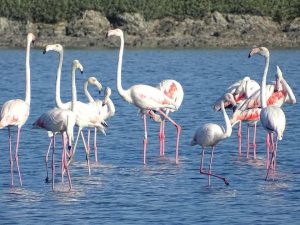
FLAMINGOS Narta Lagoon in Zvërnec Albania
Given the exceptional ecological, cultural, historical, and public significance of these territories, we respectfully request that the Committee consider whether further examination of these matters is warranted and, where appropriate, issue recommendations aimed at ensuring the full implementation of the Aarhus Convention by the Republic of Albania.
We thank you for your attention and remain available to provide any additional documentation that may assist the Committee in its assessment of this communication.
Respectfully submitted,
For the Institut Français d’Études Albanaises
Klara Buda
Founder
Paris, France