


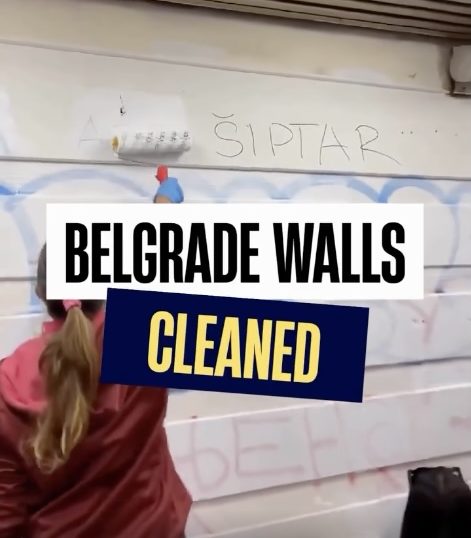
 Activists from Serbia’s Student List have started cleaning nationalist and offensive graffiti from walls across the capital, Belgrade. They also reportedly removed anti-Albanian slurs from public spaces. Video, 28 octobre, Facebook Necat Çetin
Paris, November 1, 2026
Part of a series exploring ideas in support of the Flamingo protests and Albania’s student movement.
This article does not attempt to offer a comprehensive account. It raises a few questions about what the Serbian experience might offer the protest movement in Albania. Kosovo remains a crucial test of the democratic commitments of any political force in Serbia. Here, however, the focus is on how the movement organizes and selects its representatives. Recognizing the value of those practices does not mean endorsing its participants’ positions on Kosovo.
The decision to keep Kosovo from becoming a central issue in the movement can be read as a strategic compromise: a way of avoiding divisions and maintaining a shared focus on accountability and democratic representation. This remains an interpretation, rather than a motive we can confidently attribute to everyone involved. Whether political change will also bring a willingness to acknowledge Kosovo’s independence remains to be seen. That question deserves consideration in its own right. It should neither prevent us from learning from the movement’s methods nor oblige us to overlook their political and ethical limitations.
Can the way the Serbian movement has organized offer a useful example for Albania? I believe it can, provided we distinguish what we can learn from it from what cannot simply be transplanted into our own circumstances. Our university systems differ, but those differences need to be assessed against concrete measures: research quality, university autonomy, and academic integrity.
Efforts to expose the decay within our universities by uncovering plagiarism deserve attention and support. Plagiarism is more than an academic offence: it turns stolen work into qualifications, authority, and power. A society that tolerates this fraud erodes its ability to distinguish genuine knowledge from the appearance of it.
Our problem extends beyond plagiarism to the wider acceptance of dishonesty in public life. We lie, pretend not to know, and imagine we are getting away with it. Others keep quiet to avoid damaging relationships, turn a blind eye, and carry on, even when so much is an open secret. This mutual silence allows deception to persist: people shield one another, and no one is held accountable. Under these conditions, choosing representatives with integrity matters beyond the merits of any individual candidate. It can help break the tacit agreement that makes dishonesty acceptable. But every stage of the selection process must be transparent, with candidates judged on their work and conduct against publicly stated criteria that apply equally to everyone.
What I find valuable in the Serbian example is the weight given to knowledge and public trust when choosing representatives. People with established academic reputations may be better placed to resist pressure, but a title does not guarantee integrity. Transparency, independence from party interests, and a willingness to answer for one’s actions are equally important. Nor should students’ lack of experience be mistaken for a lack of judgment or honesty.
I believe the students are on the right track. Supporting them, however, does not absolve us of the responsibility to scrutinize how they organize, choose their representatives, and guard against being used by others. Without evidence, I would not describe large numbers of them as corrupt. I would say, instead, that no one is immune to a system that rewards compliance and punishes independence. Corruption begins with even the smallest lie when lying becomes an accepted means of getting ahead. Change must therefore begin with the standards we uphold among ourselves. That takes time—and sustained effort.
Copyright klarabudapost.com CC
to publish image ask permission please: Activists from Serbia’s Student List have begun removing nationalist and offensive graffiti across Belgrade. They have also reportedly painted over anti-Albanian slurs in public spaces. Video shared on Facebook by Necat Çetin, October 28.